

Retractable Dog Leash: Pros, Cons, Safety Tips & How to Choose the Right One (2026 Guide)

Introduction
A retractable dog leash can give your dog the freedom to explore while still allowing you to stay in control. For many pet owners, it offers a more flexible walking experience than a traditional fixed-length leash. However, it also raises important questions: Are retractable dog leashes safe? Do professional trainers recommend them? And how do you know if one is the right choice for your dog?
The answer isn’t as simple as yes or no.
When used correctly, a retractable leash can be an excellent tool for calm, well-trained dogs in open environments such as parks, hiking trails, or beaches. It allows dogs to sniff, explore, and exercise more naturally while giving owners the ability to shorten the leash whenever necessary.
On the other hand, retractable leashes are not suitable for every dog or every situation. In crowded areas, busy streets, or during obedience training, the extended leash length may reduce your ability to react quickly, increasing the risk of accidents or injuries. Improper use can also lead to rope burns, tangled lines, or sudden pulling injuries for both dogs and owners.
This comprehensive guide explains everything you need to know before choosing a retractable dog leash. You’ll learn:
- What a retractable dog leash is and how it works
- The biggest advantages and disadvantages
- Common safety risks and how to avoid them
- When a retractable leash is the best choice—and when it isn’t
- How retractable leashes compare with traditional fixed leashes
- The difference between tape and cord retractable leashes
- Expert tips for selecting the right leash based on your dog’s size and lifestyle
Whether you’re buying your first retractable leash or looking for a better model, this guide will help you make an informed decision based on your dog’s needs rather than marketing claims.
What Is a Retractable Dog Leash?
A retractable dog leash is an extendable leash system that gives dogs more freedom of movement while allowing owners to adjust the leash length with a simple locking mechanism. Unlike traditional leashes, which have a fixed length of around 4 to 6 feet (1.2–1.8 meters), retractable leashes can typically extend anywhere from 10 to 26 feet (3–8 meters).
The leash is housed inside a durable plastic casing that contains a spring-loaded retraction mechanism. As your dog walks farther away, the leash smoothly extends. When your dog moves closer, or you press the brake button, the internal spring retracts the leash automatically, helping keep slack off the ground.
Most retractable dog leashes include the following components: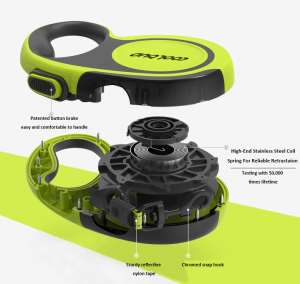
- Ergonomic Handle: Designed for comfortable one-handed use during long walks.
- Retractable Tape or Cord: Available in either flat nylon tape or round cord, depending on the model.
- Brake and Lock Button: Allows the owner to temporarily stop or permanently lock the leash at a desired length.
- Swivel Clip: Connects securely to a collar or harness while helping reduce twisting.
- Internal Spring Mechanism: Automatically retracts the leash as your dog returns.
Modern retractable leashes are available in a wide range of sizes to accommodate different breeds—from small companion dogs weighing under 15 kg (33 lbs) to large breeds exceeding 50 kg (110 lbs). Many premium models also feature reflective tape, anti-slip handles, upgraded braking systems, and reinforced webbing for improved durability.
Because retractable leashes provide greater freedom than traditional leashes, they are especially popular among owners who enjoy relaxed walks in spacious outdoor environments. However, the additional freedom also requires greater awareness and responsible handling to ensure both the dog’s safety and the safety of people nearby.
How Does a Retractable Dog Leash Work?
Understanding how a retractable leash functions can help you use it more safely and effectively.
Inside the plastic housing is a coiled spring connected to the leash tape or cord. As your dog moves forward, the spring gradually unwinds, allowing the leash to extend. When your dog slows down or walks back toward you, the spring automatically rewinds, keeping the leash under light tension and preventing excess slack from dragging on the ground.
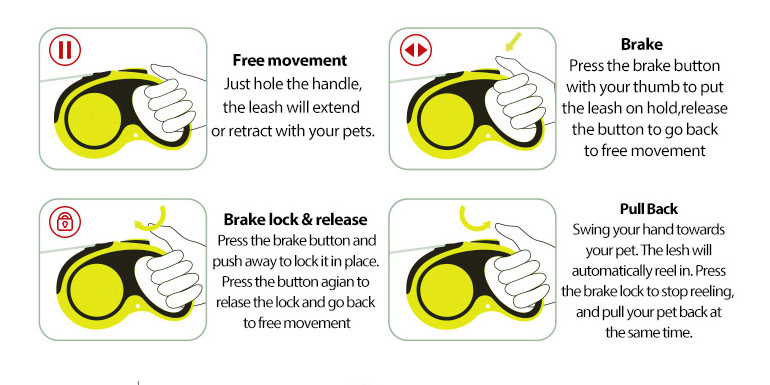
Most retractable leashes operate using a simple three-step braking system:
Free Movement Mode
Without pressing the brake button, the leash extends and retracts automatically, allowing your dog to explore within the maximum leash length.
Temporary Brake
Pressing the brake button momentarily stops the leash from extending farther. This feature is useful when approaching pedestrians, cyclists, other dogs, or road crossings.
Permanent Lock
Sliding or engaging the lock mechanism fixes the leash at a chosen length. In this mode, the retractable leash functions much like a standard leash until the lock is released.
For the best performance, owners should avoid suddenly allowing the leash to reach its maximum length. Smooth control and early braking reduce stress on the internal spring mechanism and improve overall safety for both the owner and the dog.
Pros of Retractable Dog Leashes
A retractable dog leash isn’t designed to replace a traditional leash—it serves a different purpose. When used in the right environment with a well-behaved dog, it can provide flexibility, comfort, and a more enjoyable walking experience for both the owner and the pet.
Here are the biggest advantages of using a retractable dog leash.
1. Gives Dogs More Freedom to Explore
One of the main reasons pet owners choose a retractable leash is the additional freedom it provides.
Unlike a standard leash that limits movement to about 4–6 feet (1.2–1.8 m), a retractable leash can extend up to 26 feet (8 m), allowing dogs to:
- Explore their surroundings naturally
- Sniff interesting scents
- Walk at their own pace
- Enjoy a greater sense of independence
For many dogs, especially curious and energetic breeds, this extra space creates a more enriching walking experience without requiring the owner to remove the leash.
2. Encourages Natural Sniffing Behavior
Dogs experience the world primarily through their sense of smell.
Research in canine behavior suggests that allowing dogs time to sniff during walks provides important mental stimulation and can help reduce boredom and frustration. A retractable leash gives dogs more opportunities to investigate scents while remaining under the owner’s supervision.
This makes leisurely walks more rewarding, particularly for companion dogs that spend much of their day indoors.
3. Ideal for Open Outdoor Spaces
Retractable leashes perform best in environments with ample room to move safely.
Examples include:
- Large public parks
- Open fields
- Beaches
- Forest trails
- Camping areas
- Quiet hiking paths
In these settings, owners can gradually adjust the leash length depending on the surroundings while still maintaining overall control.
4. Adjustable Walking Distance
Unlike fixed-length leashes, retractable models allow owners to change the leash length instantly.
For example:
- Shorten the leash when another dog approaches.
- Extend the leash after entering an open field.
- Lock the leash at different lengths depending on traffic or obstacles.
This flexibility makes one leash suitable for multiple walking environments.
5. Convenient One-Handed Operation
Most modern retractable leashes feature ergonomic handles and thumb-operated brake buttons.
With a simple press of the lock button, owners can:
- Stop further extension
- Lock the leash at a chosen length
- Quickly regain close control
Premium models are designed so these adjustments can be made comfortably with one hand.
6. Keeps Slack Off the Ground
Traditional leashes often develop loose loops that drag along sidewalks or trails.
A retractable leash automatically rewinds excess line, helping:
- Reduce tangling
- Prevent the leash from catching on obstacles
- Keep the walking area cleaner
- Minimize tripping hazards
This feature is especially useful during long walks on uneven terrain.
7. Suitable for Calm, Well-Trained Dogs
Retractable leashes work best for dogs that already understand basic leash manners.
Examples include dogs that:
- Respond consistently to recall
- Walk without excessive pulling
- Remain calm around strangers
- Ignore distractions
- Follow basic obedience commands
For these dogs, the additional freedom often enhances the walking experience without sacrificing safety.
Cons and Potential Risks of Retractable Dog Leashes
Although retractable leashes offer convenience and flexibility, they are not the right solution for every owner or every dog.
Understanding their limitations is essential for making an informed purchasing decision.
1. Reduced Immediate Control
The biggest disadvantage of a retractable leash is reduced control over your dog’s position.
When the leash is fully extended, your dog may be several meters away before you can react.
This can become dangerous if your dog suddenly:
- Runs toward traffic
- Chases wildlife
- Jumps on strangers
- Approaches unfamiliar dogs
- Picks up hazardous objects
For this reason, many trainers recommend keeping the leash locked shorter whenever walking near roads or crowded public spaces.
2. May Encourage Pulling
A retractable leash maintains slight tension on the line even when extending normally.
Some trainers believe that this constant forward pressure can unintentionally reward dogs for pulling because moving ahead causes the leash to continue extending.
For puppies or dogs learning loose-leash walking, a traditional fixed leash often provides clearer feedback during training sessions.
3. Risk of Rope Burn Injuries
One of the most commonly reported injuries associated with retractable leashes is friction burn.
If the cord or tape slides quickly across exposed skin, it can cause painful burns or cuts.
Owners should never:
- Wrap the leash around their hand
- Allow children to hold extended leashes unsupervised
- Grab a moving cord with bare hands
Using the handle correctly greatly reduces this risk.
4. Tangling Hazards
Long, thin leash lines can wrap around:
- Human legs
- Other dogs
- Trees
- Benches
- Bicycle wheels
If a dog suddenly changes direction while running, the resulting tension may cause falls or minor injuries.
Remaining aware of the surrounding environment helps minimize these situations.
5. Mechanical Wear Over Time
Unlike traditional nylon leashes, retractable leashes contain moving internal components.
Over time, heavy use may affect:
- Spring tension
- Locking mechanism
- Brake performance
- Housing durability
- Tape or cord integrity
Regular inspection is essential. If the leash no longer locks securely or shows visible damage, it should be replaced immediately rather than repaired.
6. Not Suitable for Every Walking Environment
Retractable leashes are generally a poor choice in:
- Busy city sidewalks
- Shopping districts
- Outdoor cafés
- Veterinary clinics
- Crowded dog events
- Obedience training classes
In these situations, keeping a dog close is usually safer and more considerate to people nearby.
7. Less Suitable for Reactive or Strong Pullers
Dogs that are highly reactive, fearful, aggressive, or extremely powerful can place significant stress on a retractable leash.
If a large dog lunges unexpectedly, the sudden force may:
- Pull the owner off balance
- Damage the locking mechanism
- Cause loss of control
Owners of powerful breeds should carefully choose a leash with an appropriate weight rating and consider whether a traditional heavy-duty leash may provide better control.
Are Retractable Dog Leashes Safe?
One of the most common questions pet owners ask is:
“Are retractable dog leashes safe?”
The short answer is:
Yes—but only when they are used correctly, in the right environment, and with the right dog.
A retractable leash is a tool, not a universal solution. Like many pet products, its safety depends more on how and where it is used than on the product itself.
When used responsibly in open spaces with a calm, well-trained dog, a retractable leash can provide freedom without sacrificing control. However, using the same leash in crowded urban environments or with an untrained dog can increase the likelihood of accidents.
Instead of asking whether retractable leashes are “good” or “bad,” a better question is:
Is a retractable leash appropriate for my dog and my typical walking environment?
When a Retractable Dog Leash Is a Good Choice
Retractable leashes perform best when owners have enough space to react, and their dogs already demonstrate good leash manners.
They are generally suitable for:
- Calm adult dogs with reliable behavior
- Dogs that respond consistently to recall commands
- Dogs that walk without excessive pulling
- Leisure walks in large parks or open fields
- Quiet hiking trails
- Beaches with plenty of open space
- Camping trips and outdoor recreation
- Experienced dog owners who understand leash management
In these situations, allowing a dog additional room to explore can provide valuable physical exercise and mental enrichment while maintaining a safe level of control.
When You Should Avoid Using a Retractable Leash
Although retractable leashes offer flexibility, there are situations where a traditional fixed-length leash is the safer option.
Avoid using a retractable leash in:
Busy Streets
Cars, bicycles, motorcycles, and pedestrians leave little room for delayed reactions. A shorter leash gives owners much better immediate control.
Crowded Sidewalks
Long leash lines can create tripping hazards for pedestrians and increase the chance of your dog approaching strangers unexpectedly.
Dog Training Sessions
Professional trainers often recommend fixed-length leashes during obedience training because they provide more consistent communication between the handler and the dog.
Teaching loose-leash walking, heel commands, or impulse control is generally easier with a standard leash.
Veterinary Clinics
Animals may already be stressed in unfamiliar environments. Keeping your dog close reduces unnecessary interactions with other pets.
Outdoor Cafés and Public Events
Extended leash lines can easily become tangled around chairs, tables, bicycles, or other people.
Around Children
Young children may not recognize an extended leash line, increasing the risk of trips and falls.
What Do Dog Trainers Think About Retractable Leashes?
Professional opinions on retractable leashes are often more balanced than many online discussions suggest.
Most experienced trainers do not oppose retractable leashes entirely. Instead, they recommend using them only after a dog has developed reliable leash manners and basic obedience skills.
Many trainers discourage retractable leashes for puppies because:
- Puppies are still learning leash pressure.
- They often pull toward exciting distractions.
- Consistent leash handling is important during early training.
For adult dogs with dependable behavior, however, a retractable leash can be a useful tool for recreational walks, scent exploration, or low-distraction outdoor environments.
The key point is that a retractable leash should complement training—not replace it.
Which Dogs Are Best Suited for a Retractable Leash?
Not every dog benefits equally from a retractable leash.
The following table can help owners determine whether one is likely to be a good fit.
| Recommended For | Not Recommended For |
|---|---|
| Calm adult dogs | Puppies in basic leash training |
| Dogs with reliable recall | Dogs that pull excessively |
| Small and medium-sized companion breeds | Highly reactive dogs |
| Well-socialized dogs | Aggressive dogs |
| Dogs comfortable in public | Dogs with poor impulse control |
| Experienced owners | First-time owners with little leash-handling experience |
Remember that personality and training matter more than breed alone.
A calm Labrador Retriever with excellent recall may be an ideal candidate, while a highly reactive small breed may be safer on a traditional leash despite its size.
How to Use a Retractable Dog Leash Safely
Using a retractable leash safely involves more than simply pressing the lock button.
Follow these best practices every time you head out:
Keep the Leash Short Near Roads
Lock the leash before approaching:
- Crosswalks
- Parking lots
- Driveways
- Bicycle lanes
Never rely on reaction time alone when traffic is nearby.
Extend the Leash Only in Open Areas
Allow full extension only when you have clear visibility and enough surrounding space.
If visibility is limited by bushes, parked cars, or sharp corners, shorten the leash immediately.
Stay Aware of Your Surroundings
Watch for:
- Cyclists
- Joggers
- Children
- Wildlife
- Other dogs
- Moving vehicles
Anticipating potential distractions gives you time to shorten the leash before problems develop.
Use a Properly Sized Leash
Every retractable leash has a maximum recommended weight rating.
Choosing a leash designed for a smaller dog than your own can place excessive strain on the spring mechanism and braking system.
Always select a model rated comfortably above your dog’s body weight.
Inspect the Leash Regularly
Before each walk, quickly check:
- Brake button
- Lock mechanism
- Tape or cord
- Swivel clip
- Housing
If any component appears damaged, replace the leash rather than attempting repairs.
Common Mistakes Dog Owners Make When Using a Retractable Leash
Even the highest-quality retractable leash cannot prevent accidents if it is used incorrectly. Here are some of the most common mistakes new dog owners make—and how to avoid them.
1. Allowing the Leash to Stay Fully Extended at All Times
Many owners assume the leash should always extend to its maximum length.
In reality, the leash length should constantly change depending on the environment.
For example:
- Keep it short near roads.
- Extend it in open parks.
- Lock it when passing other dogs.
Think of the brake button as an active safety feature, not just an emergency stop.
2. Using a Retractable Leash for Every Walk
A retractable leash is not designed for every situation.
If your daily walk includes:
- Heavy traffic
- Busy sidewalks
- School zones
- Shopping districts
A traditional leash usually provides better control.
Many experienced owners keep both types of leashes and switch depending on where they are walking.
3. Choosing the Wrong Weight Rating
Buying a leash that is too small is a surprisingly common mistake.
A leash designed for a 15 kg dog should never be used for a dog weighing 25 kg.
Always leave a reasonable safety margin rather than choosing the minimum weight capacity.
4. Ignoring Regular Maintenance
Because retractable leashes contain moving parts, they require occasional inspection.
Dirt, sand, and moisture can gradually affect the spring mechanism and locking system.
A quick inspection before each walk can help identify wear before it becomes a safety issue.
5. Expecting the Leash to Replace Training
Perhaps the biggest misconception is believing that a retractable leash can solve pulling or behavioral problems.
No leash can replace consistent obedience training.
Teaching reliable recall, loose-leash walking, and impulse control will always have a greater impact on your dog’s safety than changing equipment.
How to Maintain a Retractable Dog Leash
Proper maintenance helps extend the lifespan of your retractable leash while ensuring it continues to operate safely.
Clean the Tape or Cord
After walks on beaches, muddy trails, or rainy days:
- Wipe the tape or cord with a damp cloth.
- Remove dirt and sand.
- Allow it to dry completely before retracting.
Storing a wet leash may encourage mold or accelerate wear.
Keep the Housing Clean
Dust and debris can accumulate around the opening where the tape enters the housing.
Use a soft brush or compressed air to remove loose dirt.
Avoid immersing the entire housing in water unless the manufacturer specifically states that it is waterproof.
Inspect Moving Parts Regularly
Every few weeks, check that:
- The brake locks securely.
- The spring retracts smoothly.
- The clip rotates freely.
- The tape retracts evenly.
If any component feels rough or unreliable, discontinue use until the leash is replaced.
Store It Properly
Store the leash in a cool, dry place away from direct sunlight.
Long-term exposure to heat or UV light may shorten the lifespan of plastic components and nylon webbing.
Replace When Necessary
Even premium retractable leashes eventually wear out.
Replace the leash if you notice:
- Frayed tape
- Damaged cord
- Weak braking
- Cracked housing
- Reduced spring tension
Replacing worn equipment is always safer than attempting repairs.
Expert Recommendation
Retractable leashes are not inherently dangerous, nor are they suitable for every situation.
The safest approach is to think of them as specialized walking equipment rather than an everyday replacement for a standard leash.
For many owners, the ideal solution is to keep both types of leashes:
- A traditional fixed leash for city walks, obedience training, veterinary visits, and crowded public places.
- A retractable leash for parks, beaches, hiking trails, and other spacious environments where dogs can safely enjoy greater freedom.
By choosing the right leash for the right situation, owners can improve both safety and their dog’s overall walking experience.
Expert Buying Advice
If you’re purchasing your first retractable dog leash, don’t focus only on leash length or price.
Instead, prioritize these factors in order:
- Your dog’s behavior – A calm, responsive dog will benefit far more from a retractable leash than a dog that constantly pulls or reacts to distractions.
- The environments where you walk most often – If most of your walks take place in city streets or crowded neighborhoods, a standard leash may be your primary choice. If you frequently visit parks, beaches, or hiking trails, a retractable leash can be an excellent addition.
- Build quality over extra features – A reliable braking mechanism, durable tape, and a comfortable ergonomic handle are more important than cosmetic features or accessories.
- Comfort for both owner and dog – The best leash feels natural to use every day while keeping both you and your dog safe.
Ultimately, a retractable leash should increase your dog’s freedom without reducing your ability to stay in control.
Retractable Dog Leash vs. Standard Leash: Which One Is Better?
Many dog owners wonder whether they should choose a retractable leash or stick with a traditional fixed-length leash.
The truth is that neither option is universally better. Each serves a different purpose, and the best choice depends on your dog’s behavior, your walking environment, and your training goals.
Here’s a side-by-side comparison.
| Feature | Retractable Dog Leash | Standard Dog Leash |
|---|---|---|
| Walking Freedom | ★★★★★ | ★★☆☆☆ |
| Owner Control | ★★★☆☆ | ★★★★★ |
| Obedience Training | ★★☆☆☆ | ★★★★★ |
| City Walking | ★★☆☆☆ | ★★★★★ |
| Parks & Open Spaces | ★★★★★ | ★★★☆☆ |
| Hiking Trails | ★★★★☆ | ★★★★☆ |
| Recall Practice | ★★★★☆ | ★★★☆☆ |
| Everyday Convenience | ★★★★☆ | ★★★★★ |
| Safety in Crowded Areas | ★★☆☆☆ | ★★★★★ |
When to Choose a Retractable Leash
A retractable leash is often the better choice when:
- Walking in spacious parks or open fields
- Exploring hiking trails
- Enjoying beach walks
- Giving a calm dog more room to sniff and explore
- Practicing recall exercises in safe environments
The adjustable length allows dogs to enjoy greater freedom while owners can shorten the leash whenever necessary.
When a Standard Leash Is the Better Option
A traditional leash is generally recommended for:
- Daily neighborhood walks
- Busy sidewalks
- Veterinary visits
- Obedience training
- Crowded public spaces
- Dogs that pull excessively
- Puppies learning leash manners
Because the leash length remains fixed, owners maintain more consistent control over their dog’s movements.
Our Recommendation
Instead of choosing one over the other, many experienced dog owners keep both.
A standard leash is ideal for situations requiring close control, while a retractable leash offers additional freedom during relaxed outdoor activities.
Using each leash for its intended purpose provides the best balance between safety and enjoyment.
Tape vs. Cord Retractable Leashes
One of the most overlooked buying decisions is whether to choose a tape leash or a cord leash.
Although both function similarly, they perform differently in everyday use.
Tape Retractable Leashes
Tape leashes use a flat nylon webbing instead of a thin, round cord.
Advantages
- Easier to see from a distance
- Generally stronger for larger dogs
- Less likely to twist tightly around objects
- More durable under repeated use
- Often preferred for medium and large breeds
Disadvantages
- Slightly heavier
- Larger housing
- Usually more expensive
Tape leashes are often recommended for owners who prioritize durability and visibility.
Cord Retractable Leashes
Cord leashes use a lightweight, round nylon line.
Advantages
- Lightweight and compact
- Smooth extension and retraction
- Suitable for small companion dogs
- Usually more affordable
Disadvantages
- Harder to see in low light
- Greater risk of tangling
- May cause friction burns if handled improperly
- Less suitable for heavy pulling dogs
Cord models are generally best for smaller dogs with gentle walking habits.
Which Is Better?
For most dog owners:
Choose a tape leash if:
- Your dog weighs over 20 kg (45 lbs)
- You frequently hike or walk outdoors
- Durability is your priority
- You want better visibility
Choose a cord leash if:
- You own a small breed
- Weight and portability are important
- Your dog walks calmly
- You mainly walk in quiet neighborhoods
Overall, tape leashes offer better durability and safety, while cord leashes provide greater portability.
How to Choose the Right Retractable Dog Leash
Not all retractable leashes are created equal.
Choosing the right model involves more than simply selecting a color or length. The following factors have the greatest impact on comfort, durability, and safety.
1. Choose the Correct Weight Rating
Every retractable leash is designed for a maximum dog weight.
Selecting the correct size helps ensure the braking system and internal spring function properly.
As a general guideline:
| Dog Size | Recommended Weight Capacity |
|---|---|
| Small Dogs | Up to 15 kg (33 lbs) |
| Medium Dogs | 15–25 kg (33–55 lbs) |
| Large Dogs | 25–50 kg (55–110 lbs) |
| Extra-Large Dogs | Over 50 kg (110 lbs) |
When in doubt, choose a leash with a slightly higher weight rating than your dog’s current weight.
2. Select the Right Leash Length
Longer isn’t always better.
Different walking situations require different leash lengths.
| Length | Best For |
|---|---|
| 3 m (10 ft) | Urban walks, small parks |
| 5 m (16 ft) | Every day walking, most owners |
| 8 m (26 ft) | Beaches, hiking trails, open fields |
A 5-meter leash is often the most versatile choice for everyday recreational use.
3. Look for a Reliable Braking System
A quality braking system should:
- Lock quickly
- Release smoothly
- Operate with one hand
- Hold securely under tension
Test the brake several times before relying on it during walks.
4. Prioritize Handle Comfort
Long walks become much more enjoyable with a comfortable handle.
Look for features such as:
- Ergonomic grip
- Non-slip rubber coating
- Balanced weight distribution
- Comfortable thumb access to the brake
A well-designed handle also helps reduce hand fatigue during extended use.
5. Consider Reflective Features
If you frequently walk in the early morning or evening, reflective components improve visibility.
Helpful features include:
- Reflective tape
- Reflective stitching
- High-visibility leash colors
These features make it easier for cyclists and motorists to see in low-light conditions.
6. Evaluate Build Quality
A durable retractable leash should feature:
- High-strength nylon tape or cord
- Reinforced swivel hook
- Impact-resistant ABS housing
- Corrosion-resistant metal clip
- Smooth internal spring mechanism
Investing in a higher-quality leash often results in better long-term reliability and improved safety.
Quick Buying Checklist
Before purchasing, ask yourself:
- Is the leash rated for my dog’s weight?
- Is the length suitable for where I usually walk?
- Does it have a reliable braking system?
- Is the handle comfortable to hold?
- Does it use durable tape or cord?
- Will it be used mainly in open spaces or urban areas?
Answering these questions will help you choose a leash that matches both your dog’s needs and your everyday walking routine.
10 Essential Safety Tips for Using a Retractable Dog Leash
A retractable leash can be a valuable walking tool when used responsibly. Following these best practices helps reduce the risk of accidents and ensures a safer experience for both you and your dog.
1. Inspect the Leash Before Every Walk
Before leaving home, check that:
- The brake locks securely.
- The tape or cord is free from fraying or cuts.
- The swivel clip opens and closes properly.
- The housing has no visible cracks.
Even minor damage can affect the leash’s performance over time.
2. Never Wrap the Leash Around Your Hand
Although it may seem like a way to gain better control, wrapping the cord or tape around your hand or wrist can lead to painful friction burns or injuries if your dog suddenly runs.
Always hold the leash by its handle.
3. Lock the Leash Before Crossing Roads
Whenever approaching:
- Roads
- Parking lots
- Crosswalks
- Driveways
- Bicycle lanes
Shorten and lock the leash so your dog remains close to your side.
4. Stay Alert to Your Surroundings
Watch for:
- Other dogs
- Cyclists
- Joggers
- Wildlife
- Children
- Unexpected obstacles
Good leash handling starts with anticipating potential distractions before your dog reacts.
5. Use a Harness When Appropriate
Many veterinarians and trainers recommend attaching retractable leashes to a properly fitted harness rather than directly to a collar.
A harness distributes force more evenly across the chest and shoulders, helping reduce pressure on the neck if your dog suddenly reaches the end of the leash.
6. Keep the Leash Short in Crowded Areas
Busy sidewalks, markets, festivals, and outdoor cafés require close control.
Lock the leash at a shorter length whenever people or other animals are nearby.
7. Do Not Exceed the Weight Rating
Always choose a leash designed for your dog’s size.
Using a leash intended for smaller dogs may overload the spring and braking mechanism, increasing the risk of equipment failure.
8. Replace Worn or Damaged Leashes Promptly
Do not continue using a retractable leash if you notice:
- Frayed tape or cord
- Weak spring tension
- Faulty locking mechanism
- Loose handle
- Cracked housing
Replacing a worn leash is far safer than attempting temporary repairs.
9. Avoid Using Retractable Leashes During Basic Training
When teaching commands such as:
- Heel
- Loose-leash walking
- Stay
- Leave it
- Recall
A traditional fixed-length leash usually provides clearer communication and more consistent control.
10. Match the Leash to the Situation
No single leash is perfect for every walk.
Experienced dog owners often switch between a retractable leash and a traditional leash depending on the environment.
Choosing the right tool for the situation is one of the simplest ways to improve safety.
Frequently Asked Questions
Are retractable dog leashes bad?
Not necessarily. Retractable leashes are not inherently bad—they simply serve a different purpose than standard leashes. They work best for calm, well-trained dogs in open environments where owners have enough space to manage the additional leash length safely.
Why do some dog trainers dislike retractable leashes?
Many trainers discourage retractable leashes during obedience training because the constantly extending line can encourage pulling and reduce precise control. However, many also agree they can be useful for recreational walks once a dog has developed good leash manners.
Can puppies use a retractable leash?
Most trainers recommend beginning with a standard fixed-length leash while puppies learn basic leash skills. Once a puppy consistently walks calmly and responds to commands, a retractable leash may be introduced in appropriate environments.
Are retractable leashes suitable for large dogs?
Yes, provided the leash is specifically designed for the dog’s weight and strength. Large breeds require heavy-duty models with reinforced tape, durable braking systems, and higher weight ratings.
Should I choose a tape or cord retractable leash?
Tape leashes generally offer greater durability, improved visibility, and better performance for medium and large dogs. Cord leashes are lighter and more compact, making them suitable for many small breeds.
How long should a retractable dog leash be?
For most owners, a 5-meter (16-foot) leash offers an excellent balance between freedom and control. Longer 8-meter (26-foot) models are better suited for open spaces such as beaches, parks, or hiking trails.
Can retractable dog leashes break?
Like any mechanical product, retractable leashes can wear out over time. Regular inspection and proper maintenance help reduce the risk of failure. If the tape, cord, spring, or locking mechanism becomes damaged, the leash should be replaced.
Is a retractable leash better than a traditional leash?
Neither is universally better. Retractable leashes provide greater freedom for recreational walks, while traditional leashes offer superior control in busy environments and during training.
Should a retractable leash be attached to a collar or harness?
For most dogs, a well-fitted harness is the better choice because it distributes force more evenly across the body and reduces strain on the neck during sudden stops.
How long does a retractable dog leash typically last?
The lifespan depends on build quality, frequency of use, and maintenance. A high-quality retractable leash that is inspected regularly and used within its weight limit can provide reliable performance for several years.
Conclusion
A retractable dog leash can be an excellent choice for owners who want to give their dogs more freedom while maintaining control. When used in spacious environments with a calm, well-trained dog, it encourages natural exploration, provides mental stimulation, and makes walks more enjoyable.
However, retractable leashes are not intended to replace traditional fixed-length leashes in every situation. Busy streets, crowded public areas, and obedience training often require the close control that a standard leash provides.
Ultimately, the best leash is the one that matches your dog’s behavior, your walking environment, and your level of experience. By understanding the strengths and limitations of each type of leash, you can make a more informed decision and create a safer, more enjoyable walking experience for both you and your dog.
Reviewed by the KUDI Product Team
This article was reviewed by our product specialists with years of experience designing and manufacturing pet walking accessories. We continuously monitor industry best practices and customer feedback to ensure our content remains practical, accurate, and up to date.
Post time: Jun-26-2026